

Raina Shroff is a rising senior studying Architecture and Film Production at Northeastern University in Boston. Raina chose creative direction and architecture to have a meaningful impact on her surrounding community through spatial design. In her free time, she enjoys watching movies, traveling the world, spending time with friends, and designing sets for theatre, film, fashion and magazines. During her 7-month co-op at West Work, Raina participated in programs with AIAS, Habitat for Humanity, The Boston Society of Architects, Boston Public Schools, and The Northeast Sustainable Energy Association where she saw firsthand how much community engagement drives considerate design.
During my time at West Work, I’ve had the opportunity to participate in meetings, field visits, and community events that introduced me to the people behind every project. More than any technical skill, this internship has shown me firsthand how meaningful community engagement is to the design process and how architecture can shape people’s everyday lives.


This past spring semester, I worked as a Service Director and volunteer for Habitat for Humanity and as a Mentorship Representative for the American Institute of Architecture Students at Northeastern University. These opportunities allowed me to support undergraduate students and peers while also contributing to efforts that improve living conditions for those experiencing homelessness or food insecurity. These experiences taught me that service and advocacy are important parts of the design profession. My internship at West Work showed me what those ideas look like in practice.


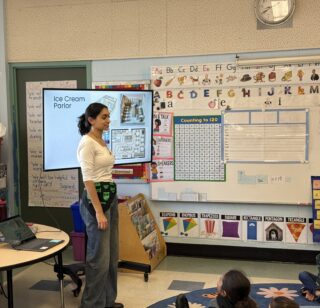
West Work brought me much closer to understanding how architects can engage with both future generations and the communities already living in the spaces we help shape. In the spring, I volunteered alongside my coworker Noah Anderson during a BSA-led architecture visit to students at the Maurice J. Tobin K–8 School. Working with the students showed me how early exposure to design can help children see themselves as active participants in shaping their neighborhoods.
We asked students to identify the places they use every day, such as schools, homes, playgrounds, and then we asked them to imagine new spaces of their own. Together, those ideas became a neighborhood that reflected the entire class. It was incredibly rewarding watching them think critically about the places they inhabit. The activities proved how early design education can engage future community members and why children’s perspectives deserve consideration in projects that shape everyday life.


I was also lucky enough to attend a NESEA Pro Tour of the Castle Square Eva White Apartments hosted by WinnCompanies and the Castle Square Tenants Organization. The tour highlighted the building’s exterior systems, which were designed to support an occupied rehabilitation of the property. It was incredible to see not only the iterative complexity of the project, but also the care taken to ensure tenants remained at the center of the process. While the façade system and prefabricated wall panels were technically impressive, what stood out most was how every decision supported the residents who continued living in the building throughout construction.


Altogether, these experiences have reshaped the way I think about architecture and space. West Work has not only provided opportunities to learn from these experiences but has also demonstrated what it means to be genuinely invested in clients, residents, and the broader communities affected by design decisions. Whether mentoring students, volunteering in the community, or learning directly from residents, every experience reinforced that design is ultimately about people. Buildings may be the final product, but relationships, trust, and community are what give them meaning. This has changed my perspective and I know that when I leave, my ability to research, understand, and appreciate the people connected to a project will continue to shape my approach to design.

